
Password & Authentication Security
Jul 6, 2025
Strong Passwords vs. Passphrases: Which Is Better?
Introduction
As cyber threats continue to target user credentials, the way passwords are created has become just as critical as how they are protected. Many systems still rely on traditional complex passwords, while others encourage longer passphrases made of multiple words. Both approaches aim to prevent unauthorized access, but they work in different ways. Understanding how each method performs in real-world conditions helps users and organizations choose the safer option.
What Is a Strong Password?
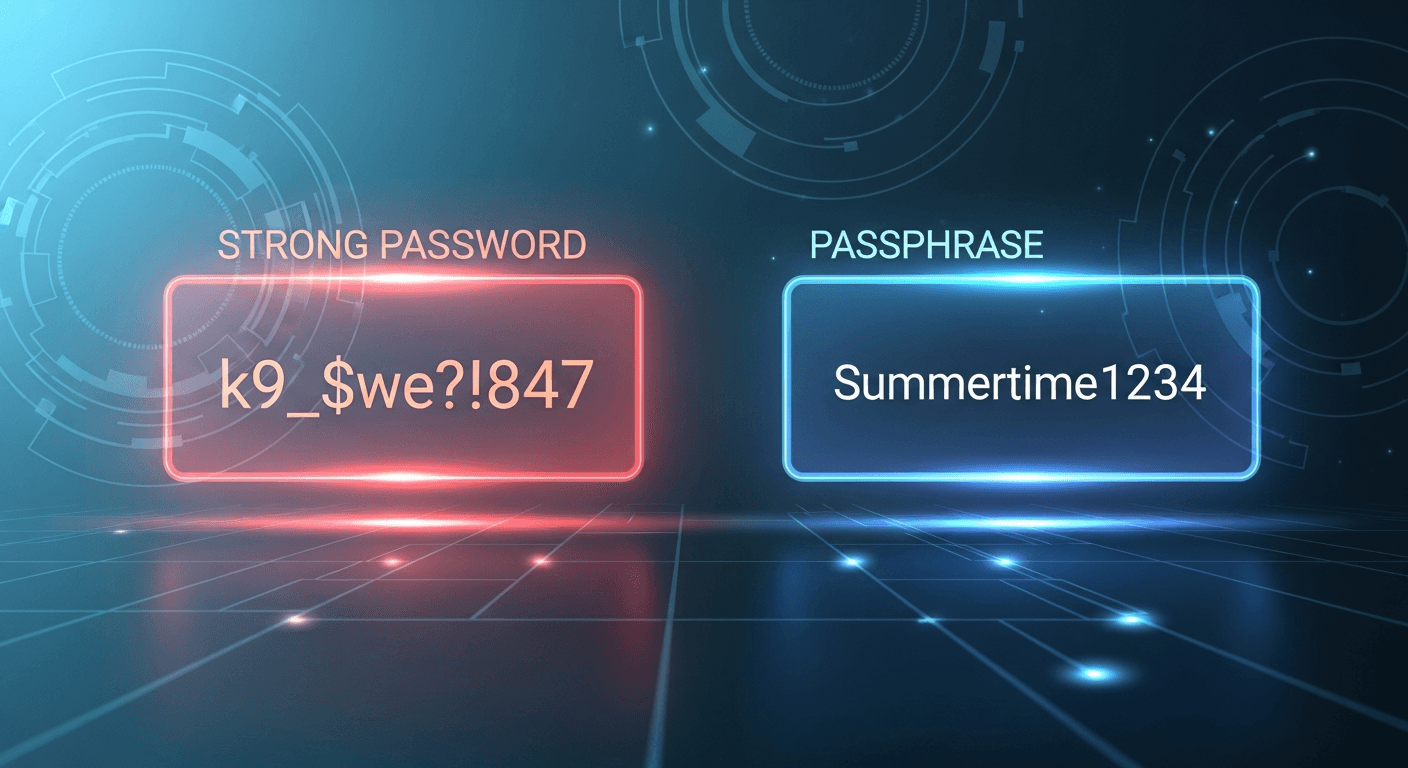
A strong password is typically a short string of characters that combines uppercase and lowercase letters, numbers, and symbols. Examples include random-looking combinations that are difficult to guess or predict.
These passwords are designed to resist brute-force and dictionary attacks by increasing complexity. However, they are often hard to remember, which leads users to reuse them, write them down, or slightly modify the same password across multiple accounts.
What Is a Passphrase?
A passphrase is a longer sequence of words, often combined with spaces or symbols. Instead of relying on complexity through symbols, passphrases rely on length.
For example, a passphrase may consist of several unrelated words that form a sentence-like structure. This makes passphrases easier for humans to remember while still being difficult for automated tools to crack due to their length.
Security Strength Comparison
From a technical perspective, password strength depends on how many possible combinations an attacker must try. Length plays a major role in this calculation.
A long passphrase often provides more resistance to brute-force attacks than a short but complex password. Even if a passphrase contains only letters, the increased length dramatically raises the number of possible combinations.
Short passwords with many symbols can still be broken faster than long phrases if they are reused or partially predictable.
Usability and Human Behavior
Security is not only about mathematics; it is also about how users behave. Complex passwords are more likely to be forgotten, reused, or stored insecurely.
Passphrases are generally easier to remember, which reduces risky behaviors such as writing passwords on paper or reusing them across services. When users can remember their credentials naturally, overall account safety improves.
Resistance to Common Attacks
Passphrases perform well against brute-force attacks due to their length. They are also less likely to appear in common password lists, especially when the words are not part of a common phrase.
Strong passwords remain effective when they are truly random and unique, but their effectiveness drops quickly when users rely on patterns or reuse them.
Role of Password Managers and MFA
Both passwords and passphrases benefit greatly from password managers, which remove the need for memorization and allow truly unique credentials for every account.
When combined with multi-factor authentication, either approach becomes significantly safer, as stolen credentials alone are not enough to gain access.
Organizational Perspective
Many organizations now encourage passphrases instead of traditional complex passwords. This approach reduces helpdesk calls, improves user compliance, and maintains strong protection when paired with length requirements and additional authentication controls.
Blocking common passwords and enforcing minimum length standards further improves results regardless of the chosen method.
Conclusion
Between strong passwords and passphrases, length and uniqueness matter more than complexity alone. Passphrases often provide better real-world protection because they balance security with usability. When supported by password managers and multi-factor authentication, passphrases offer a practical and effective way to protect accounts in modern environments.